Talk to the Veterans Crisis Line now


An official website of the United States government

|
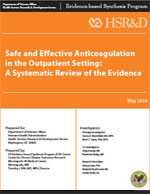
Investigators: Hanna E. Bloomfield, MD, MPH; Brent C. Taylor, PhD, MPH; Ange Krause, MD; and Preetham Reddy, MD. VA Evidence-based Synthesis Program (ESP) Center
Center for Chronic Disease Outcomes Research
Minneapolis VA Medical Center Washington (DC): Department of Veterans Affairs; February 2011. |
Download PDF: Complete Report, Executive Summary, Report, Appendices
Long term anticoagulation with vitamin K antagonists (e.g., warfarin) has been shown to reduce major thromboembolic complications in patients with many common chronic conditions (atrial fibrillation; history of deep vein thrombosis and pulmonary embolism; mechanical heart valves.) However, vitamin K antagonists have a very narrow therapeutic window requiring frequent laboratory monitoring to ensure that patients are neither excessively anti-coagulated, which increases the risk for bleeding, or under anti-coagulated, which increases the risk for thromboembolism.
In this systematic literature review, the following key questions were addressed:
A Synthesis of the Evidence: Safe and Effective Anticoagulation in the Outpatient Setting (VA HSR&D Management e-Brief)
Cyber Seminar on Safe and Effective Anticoagulation in the Outpatient Setting
Bloomfield H, Krause A, Greer N, Taylor BC, MacDonald R, Rutks I, Reddy P, Wilt TJ. Meta-analysis: Effect of Patient Self-testing and Self-management of Long-Term Anticoagulation on Major Clinical Outcomes. Ann Intern Med. 2011 Apr 5;154(97):472-482.