Talk to the Veterans Crisis Line now


An official website of the United States government
Principal Investigator:
Remy R. Coeytaux, M.D., Ph.D.
Co-Investigators:
Jennifer McDuffie, Ph.D.
Adam Goode, D.P.T., Ph.D.
Sarah Cassel, B.A.
Wei Duan Porter, M.D.
Poonam Sharma, Ph.D.
Sreelatha Meleth, Ph.D.
Hilary Minnella, B.A.
John W. Williams, Jr., M.D., M.H.Sc./
Download PDF: Complete Report, Executive Summary, Report, Appendices
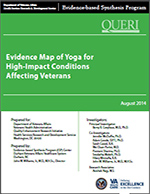
Patient-centered care supports the active involvement of patients and their families in the decision-making process between options for treatment. Part of this mission is to identify, develop, and implement new practices and approaches that are found to be effective in promoting the transformation to a patient-centered model and improved patient care. Complementary and alternative medicine (CAM) strategies such as yoga are widely available in the private sector, and some Veterans would like access to these strategies through the Veterans Affairs (VA) system. Determining the state of evidence on the benefits and harms of yoga and other CAM modalities is a priority for the Veterans Health Administration (VHA).
To fulfill the joint research needs of the Office of Patient Centered Care and the Field Advisory Committee on Complementary and Alternative Medicine, and to help VA leadership determine the most appropriate guidelines/policy for the implementation of CAM therapies within the VA, the Evidence-based Synthesis Program Coordinating Center proposed a CAM evidence mapping project to evaluate the existing evidence on yoga for common clinical conditions in Veterans.